
 AI
Saudi Arabia’s purchasing managers’ index fell to 48.8 in March 2026 as the 2026 conflict disrupted shipping through the Strait of Hormuz, and was back to 54.0 by October. Order books are growing again, but exports are still falling and freight and insurance keep pushing costs up. For manufacturers, distributors and equipment dealers, 2026-27 is about selling and servicing more of what is made in the region.
Saudi Arabia’s PMI in October 2026, up from 48.8 in March, when the conflict hit supply routes.
Riyad Bank PMI, 2026industrial facilities in Saudi Arabia in 2025, about 36% of the 36,000 targeted by 2035.
Arab News, 2026of Saudi non-oil exports in 2025, a record and up 15%. Re-exports rose 53% to SR139bn.
SPA, 2026of UAE industrial exports in 2025. Industry now contributes Dh200bn, a 70% increase since 2021.
The National, 2026In brief
The four things to know before you plan.
- The Saudi PMI fell to 48.8 in March 2026, the first contraction in nearly six years, and recovered to 54.0 in October as new orders kept rising.
- Saudi Arabia had 12,946 industrial facilities in 2025, about 36% of its 2035 target of 36,000, and industry and related sectors contributed SR1.05 trillion, 39% of non-oil GDP (Arab News).
- Saudi non-oil exports hit a record SR624 billion in 2025, up 15% (SPA), but the 2026 conflict turned export orders down, so margin by customer and route now matters more than volume.
- Local content is becoming a rule: Saudi minimum local content requirements for government procurement rise every August from 2026 to 2031, and the UAE made In-Country Value mandatory for federal entities and companies at least 25% government-owned in April 2026.
The market, country by country
| Market | Industrial base | 2026 signal | What to watch in 2026-27 |
|---|---|---|---|
| Saudi Arabia | 12,946 industrial facilities (2025); industry and related sectors 39% of non-oil GDP; record SR624bn non-oil exports in 2025 | PMI 48.8 in March, 54.0 in October; export orders down eight months running | Next step-up in minimum local content on 1 August 2027; next wave of project awards expected from 2027 |
| United Arab Emirates | Industry contributes Dh200bn; manufacturing 12.8% of non-oil GDP (2025) | PMI 55.3 in September; selling prices rising at the fastest rate in more than 15 years | Mandatory In-Country Value for state entities; Make it in the Emirates, 3 to 6 May 2027 |
| Egypt | Non-oil exports $48.5bn in 2025, up 17% | Non-oil manufacturing +9% in FY2025/26; PMI at a 41-month low of 46.0 in June | 117 new SCZONE industrial-zone projects; $100bn industrial exports target by 2030 |
Sources: Arab News; Riyad Bank and S&P Global PMI; The National; Gulf News (FCSC data); Zawya; Business Today Egypt; Xinhua; Daily News Egypt. Qatar is not covered in this edition.
Six shifts to plan for
What is changing in the market, with the evidence for each shift.
3.1Supply routes set the pace
The Saudi PMI fell to 48.8 in March 2026, the first contraction in nearly six years, as supplier delivery times lengthened the most since June 2020 (Trading Economics). By October it was back to 54.0, but export orders had fallen for an eighth month and purchase prices rose at their fastest pace in six months, on freight, insurance, raw material and energy costs (Riyad Bank PMI, reported by Arab News). The IMF assumes shipping through Hormuz starts to reopen in March 2027. Until then, every quote and delivery date depends on lead times that change week to week.
3.2Saudi capacity keeps growing
Saudi Arabia had 12,946 industrial facilities in 2025, about 36% of the 36,000 its National Industrial Strategy targets by 2035, and industry and related sectors contributed SR1.05 trillion, 39% of non-oil GDP (Arab News, Arabian Business). In June 2026 alone the ministry issued 364 licences worth SR4.46 billion, and 164 factories started production. New plants need distributors, dealer networks and service teams from their first order.
3.3Saudi exports need new routes
Saudi non-oil exports reached a record SR624 billion in 2025, up 15%, and re-exports rose 53% to SR139 billion, passing SR100 billion for the first time (SPA). In 2026 the conflict turned that around: export orders have fallen for eight months in a row, with firms citing shipping disruption and higher freight and insurance costs (Riyad Bank PMI, reported by Arab News). Exporters need to know which customers, routes and products still carry a margin, and distributors need to sell more at home.
3.4Local content becomes a rule
Saudi Arabia’s LCGPA introduced minimum local content requirements for government procurement from 1 August 2026, rising every year to 2031 (Global Trade Alert). Local content already reached nearly 47% of government procurement in 2024, against a 45% target, and the Mandatory List held about 1,200 products (Argaam). In April 2026 the UAE made its In-Country Value programme mandatory for federal entities and companies with a government stake of 25% or more, and set up a Dh1 billion fund to localize more than 5,000 critical products (The National). Suppliers need certificates, bills of materials and supplier data they can produce on request.
3.5Project demand slows, the installed base matters more
Saudi giga-project awards reached $10.6 billion so far in 2026, against $31.7 billion in 2023, mainly because NEOM has scaled back. MEED expects the next wave from 2027, tied to King Salman International Airport, Expo 2030 and the 2034 World Cup (Skift). Caterpillar’s construction sales in Europe, Africa and the Middle East still rose 12% in the third quarter of 2026. For equipment dealers, parts, service contracts and fleet utilization carry more of the year.
3.6The UAE buys local, Egypt sells abroad
UAE firms reported switching to domestic suppliers while foreign inputs stayed hard to source (S&P Global, reported by The National), and Make it in the Emirates 2026 raised industrial procurement opportunities to Dh180 billion over the next decade (The National). In Egypt, non-oil manufacturing grew 9% in FY2025/26 (Business Today Egypt) and non-oil exports rose 17% to $48.5 billion in 2025 (Xinhua), while the Egypt PMI fell to a 41-month low of 46.0 in June 2026 (S&P Global), so growth there comes from export orders more than home demand.
Three ways 2027 could go
One base case from published forecasts, and what to do if it runs slower or faster.
The IMF’s October 2026 World Economic Outlook assumes shipping through the Strait of Hormuz starts to reopen in March 2027, with shipping broadly back to normal by October 2027, and projects strong 2027 growth after a 2026 contraction (Saudi Arabia +7.9%, UAE +7.7%).
Protect margin and cash: reprice quotes for freight and insurance, sell parts and service on the installed base, and plan stock against longer lead times.
Be ready for the 2027 project wave: capacity plans, dealer allocation and quote pipelines that move as soon as shipping routes reopen.
Dates to watch
- 12 to 14 January 2027Future Minerals Forum in Riyadh, where Saudi Arabia sets out its mining and minerals supply plans.
- March 2027IMF base case: shipping through the Strait of Hormuz starts to reopen, with shipping back to normal by October 2027.
- 3 to 6 May 2027Make it in the Emirates, ADNEC Centre Abu Dhabi, where the UAE announces its next procurement and localization deals.
- 1 August 2027Next step-up in Saudi minimum local content requirements for government procurement, with further increases each year to 2031.
Where to start
Where Arcsen would start, and the page that explains each one.
Every shift in this outlook lands on three records: the quote, the volume agreement and the account forecast. When those live in spreadsheets, a freight increase takes weeks to reach open quotes, nobody sees which distributor is behind plan, and local content evidence is rebuilt for every tender. Manufacturing Cloud and Revenue Cloud are built for exactly this work; our guide to both explains how they split the work.
| Shift | What you need to manage | Where it runs in Salesforce |
|---|---|---|
| Supply routes set the pace | Reprice open quotes when freight, insurance or input costs move, and quote lead times you can keep | Revenue Cloud: Salesforce Pricing and Product Configurator |
| Saudi capacity keeps growing | Sell through distributors from the first order, with one pipeline and a forecast per partner | Manufacturing Cloud: Account Forecasting and partner visits, with an Experience Cloud partner portal |
| Saudi exports need new routes | See margin by customer, product and route, using the prices you actually invoiced | Manufacturing Cloud sales agreements, with realized prices from the ERP |
| Local content becomes a rule | Show origin, certificates and local content data on every product and every tender quote | Revenue Cloud product catalogue, with certificate data on account and product records |
| Project demand slows | Grow run-rate volumes, service contracts, parts and warranty on the installed base | Manufacturing Cloud sales agreements and Warranty Lifecycle Management, with Field Service |
| The UAE buys local, Egypt sells abroad | Turn new local buyers into volume commitments, and quote export customers in their currency and terms | Revenue Cloud quotes, then Manufacturing Cloud sales agreements |
Four places to start:
Quote to agreement on one record
Revenue Cloud for configured quotes priced with current freight and lead times, and Manufacturing Cloud for sales agreements and run-rate forecasts.
Manufacturing Cloud and Revenue Cloud →Service on the installed base
Field Service and Service Cloud for parts, warranty, service contracts and technician scheduling across the fleet you have sold.
Field Service →ERP data in front of sales
MuleSoft connects ERP, stock and price lists to sales and service, so the dates you promise match the stock you hold.
MuleSoft integration →Agents for dealers and distributors
Agentforce answers order status, availability and parts questions in Arabic and English, and hands over to a person with full context.
Agentforce →Priorities for the next 12 months
- Reprice open quotes and contracts for current freight, insurance and input costs, and show lead times customers can rely on.
- Build the evidence for local content and In-Country Value: supplier, bill-of-materials and certificate data in one place.
- Move service revenue onto contracts: map the installed base, warranty end dates and parts demand by customer.
- Give dealers and distributors one pipeline and one forecast, so allocation follows demand.
- Put an AI agent on order status and parts availability questions, with a human handover.
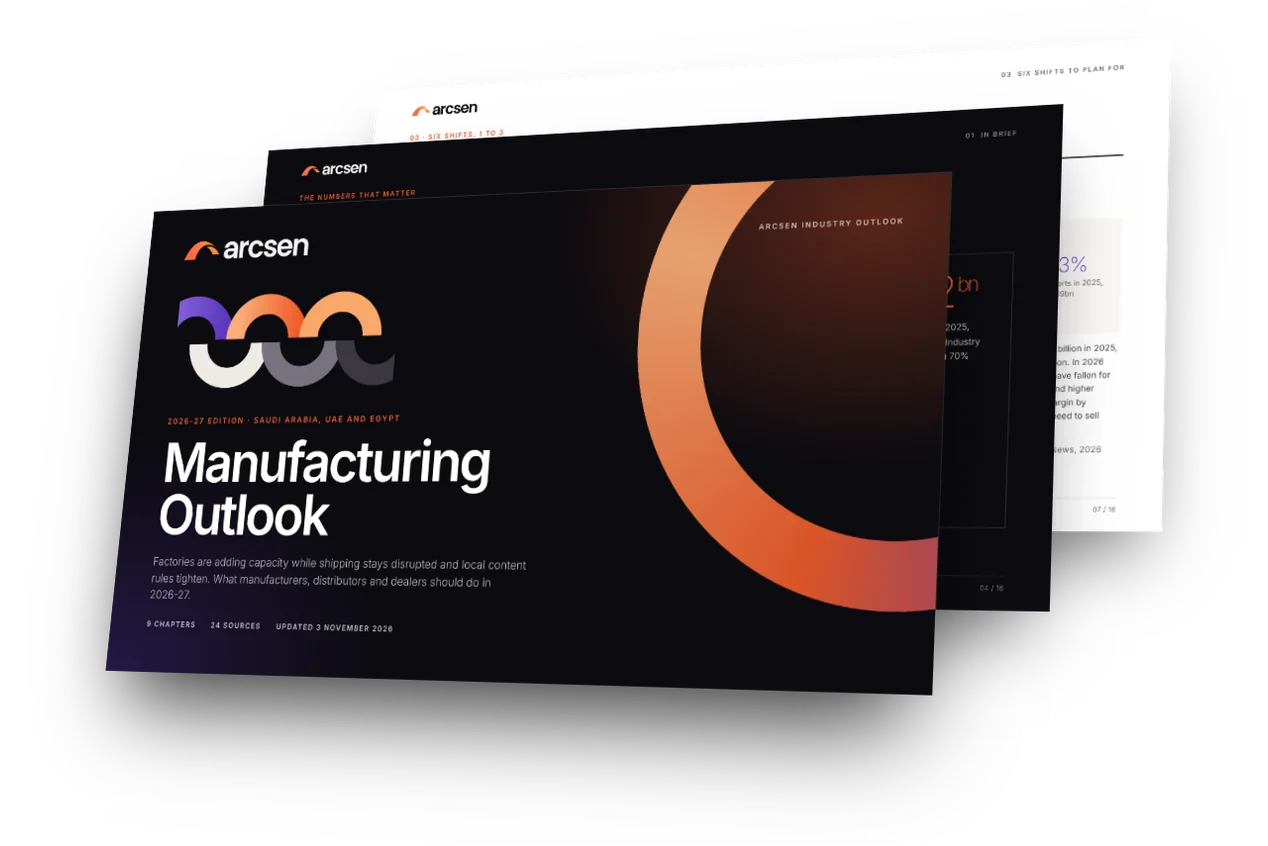
- 17Pages
- 9Chapters
- 24Sources
Take the outlook into your planning meeting.
The same research as this page, designed as 17 landscape pages with charts, a 2026-27 timeline and a priorities checklist. Free to download and share with your team.
Questions leaders ask
How did the 2026 conflict affect manufacturing in Saudi Arabia?
The Riyad Bank Saudi Arabia PMI fell to 48.8 in March 2026, the first contraction in nearly six years, as supplier delivery times lengthened the most since June 2020. It recovered to 54.0 by October 2026, but export orders fell for an eighth month and input costs rose at their fastest pace in six months.
How many factories does Saudi Arabia have?
Saudi Arabia had 12,946 industrial facilities in 2025, about 36% of the National Industrial Strategy target of around 36,000 factories by 2035, according to Arab News. Industry and related sectors contributed SR1.05 trillion, 39% of non-oil GDP.
What are Saudi Arabia’s local content rules for suppliers?
From 1 August 2026, Saudi Arabia’s Local Content and Government Procurement Authority set minimum local content requirements for products on its Mandatory List in government procurement, with increases every August to 2031 (Global Trade Alert). Local content reached nearly 47% of government procurement in 2024 (Argaam).
Is In-Country Value mandatory in the UAE?
Since April 2026 the National In-Country Value programme is mandatory across selected sectors, covering federal entities and companies in which the government holds 25% or more, according to The National. The UAE also set up a Dh1 billion National Industrial Resilience Fund.
How big is UAE industry?
Industry contributes Dh200 billion to the UAE economy, a 70% increase since 2021, and industrial exports reached Dh262 billion in 2025, including Dh92 billion of advanced industrial exports (The National). Manufacturing was 12.8% of non-oil GDP in 2025 (FCSC data, reported by Gulf News).
Other outlooks for 2026-27
Eight more sectors, researched and sourced the same way.
Financial services outlook
Slower bank growth and tighter funding, open banking licensed in Saudi Arabia, real-time payments and fintech competition.
Read the outlook →Insurance outlook
Premiums growing faster than profits, risk-based capital from January 2027, consolidation and rising health costs.
Read the outlook →Travel and transportation outlook
Recovery after the 2026 disruption, Saudi domestic travel, new airlines and rail, biometrics and AI.
Read the outlook →Retail and distribution outlook
Resident-led demand, electronic payments, paid membership, retail media, Egypt’s prices and e-invoicing.
Read the outlook →Public sector outlook
Agentic AI in government, published citizen-experience scores, single front doors and fewer steps.
Read the outlook →Healthcare outlook
Saudi health clusters, virtual care at scale, UAE health records, Egypt’s insurance rollout and supervised AI.
Read the outlook →Education outlook
National admissions platforms, AI in the curriculum, Dubai’s private-sector growth and cross-border recruitment.
Read the outlook →Automotive outlook
Deferred demand, weak brand loyalty, Chinese brands, aftersales, EV charging and new Saudi plants.
Read the outlook →Talk to the people behind this outlook
To discuss what it means for your organization, contact us directly.


Planning for 2026-27?
Talk to the people delivering Salesforce, Sitecore and Agentforce in Dubai, Riyadh, Jeddah, Doha and Cairo.
Sources and method
Arcsen is a Salesforce Summit Partner and Sitecore partner with teams in Dubai, Riyadh, Jeddah, Doha and Cairo. This outlook uses official statistics, regulator and government publications, company filings and established research, checked on 3 November 2026. Where a figure comes from a news report of official data, the source below names both. We update this page as new data is published.
- IMF cuts 2026 growth forecasts for Gulf economies due to prolonged Hormuz closure, The National, 13 October 2026.
- Saudi non-oil output growth picks up despite regional disruption, Arab News, 3 November 2026.
- Saudi non-oil PMI tumbles to second lowest on record (March 2026 data), Trading Economics, 2026.
- Riyad Bank Saudi Arabia PMI, September 2026, S&P Global, 5 October 2026.
- Saudi factory investment doubles to over $1bn in June, Arab News, 29 September 2026.
- Saudi Arabia targets 36,000 factories and $373.3bn industrial GDP by 2035, Arabian Business, 3 December 2025.
- Saudi Arabia: LCGPA introduces and increases minimum local content requirements for government procurement, Global Trade Alert, February 2026.
- Saudi non-oil exports record historic performance in 2025, SPA, 20 April 2026.
- LCGPA aims to up local content share in gov’t procurement to 50%, Argaam, 1 May 2025.
- Riyadh to host sixth edition of Future Minerals Forum in January 2027, Global Mining Review, October 2026.
- Saudi giga project spending shrinks as Neom scales back, Skift, citing MEED, 28 October 2026.
- “Those who build, own their future,” says Dr Sultan Al Jaber in push for greater industrial base, The National, 4 May 2026.
- UAE sets up Dh1bn fund to support industrial sector, The National, 26 April 2026.
- UAE non-oil sector records fastest growth since December 2024, The National, 3 September 2026.
- UAE announces nearly $47 billion in industrial deals at Make it in the Emirates summit, The National, 15 May 2026.
- UAE economy grows 6.2% in 2025 as GDP hits Dh1.9 trillion, non-oil sector surges 6.8%, Gulf News, citing FCSC, 30 May 2026.
- UAE’s non-oil firms hike prices at fastest rate in over 15 years: PMI, Zawya, 5 October 2026.
- Plan your visit, Make it in the Emirates, 2026.
- Egypt’s economy grows 5.1% in FY2025/2026, Business Today Egypt, 3 September 2026.
- S&P Global Egypt PMI, July 2026, S&P Global, 4 August 2026.
- Egypt’s non-oil exports up 17 pct to 48.5 bln USD in 2025, Xinhua, citing the Ministry of Investment and Foreign Trade, 27 January 2026.
- Egypt’s SCZone revenue jumps 37% to record $314m in FY2025/26, Arab News, 16 July 2026.
- Egypt unveils updated Industrial Development Strategy 2030, targets $100bn in exports, Daily News Egypt, 10 June 2026.
- Caterpillar Inc. 3Q 2026 earnings release, Caterpillar, 29 October 2026.