
 AI
Saudi insurers wrote SAR 84.3 billion of premiums in 2025, up 10.7%, while the sector’s net profit fell 47% to SAR 1.9 billion. Growth is there. Margins, claims costs and a new capital regime from January 2027 are the hard part. For insurers, takaful operators and brokers in Saudi Arabia, the UAE and Egypt, 2026-27 is about pricing, claims and service that stand up to a regulator, a reinsurer and a customer on the same day.
gross written premiums in Saudi Arabia in 2025, up 10.7%, with health at 57% of the market.
Insurance Authority, 2026Saudi insurance sector net profit in 2025, down to SAR 1.9bn, as claims costs outran premium growth.
Insurance Authority, 2026Saudi risk-based capital rules become mandatory, after a parallel run through 2026.
Insurance Authority via Arab News, 2026UAE gross written premiums in 2025, up 14.9%; health policies rose 26% after the national mandate.
CBUAE via Khaleej Times, 2026In brief
The four things to know before you plan.
- Saudi premiums rose 10.7% to SAR 84.3 billion in 2025, but sector net profit fell 47% to SAR 1.9 billion, and more than 65% of listed insurers made technical losses (Insurance Authority, AM Best).
- Risk-based capital becomes mandatory in Saudi Arabia on 1 January 2027; with 24 listed insurers and the top five holding about 77% of revenue, more mergers are expected (Moody’s).
- Health is 57% of the Saudi market, and Middle East medical costs are expected to rise 11.3% in 2026 (WTW), so claims control and member service decide the loss ratio.
- The UAE grew 14.9% to AED 74.8 billion in 2025 under a national health mandate and new licensing rules; Egypt grew 22.5% to EGP 130.8 billion under its 2024 Unified Insurance Law.
The market, country by country
| Market | 2025 premiums | 2026 signal | What to watch in 2026-27 |
|---|---|---|---|
| Saudi Arabia | SAR 84.3bn, up 10.7%; health 57%; sector net profit down 47% to SAR 1.9bn | Q1 premiums SAR 29.8bn, up 14.4%; net combined ratio 98.3%; mergers under way | Risk-based capital mandatory from 1 January 2027; open insurance and insurtech rules; national strategy target of about SAR 150bn by 2030 |
| United Arab Emirates | AED 74.8bn, up 14.9%; 58 insurers; industry profit AED 4.0bn | New licensing regulation applied from 14 August 2026; health policies up 26% after the mandate | Broker and telemarketing rules; open finance for motor, health, life and property |
| Egypt | EGP 130.8bn, up 22.5%; claims EGP 64.4bn, up 38% | About 80 decisions under the 2024 Unified Insurance Law; first MGA framework; takaful contributions up 25.6% in Q1 | Digital-only policies; universal health insurance phase 2 (no start date yet) |
Sources: Insurance Authority; Milliman; Moody’s and S&P via EnterpriseAM; CBUAE via Khaleej Times; Middle East Insurance Review; FRA. Egypt reported an earlier 2025 total of EGP 110.1bn; we use the later FRA figure. Qatar is not covered in this edition.
Six shifts to plan for
What is changing in the market, with the evidence for each shift.
3.1Premiums grow, margins do not
Saudi gross written premiums rose 10.7% to SAR 84.3 billion in 2025, but sector net profit fell 47% to SAR 1.9 billion (Insurance Authority). Across the listed insurers the loss ratio rose to 89.3% and return on equity fell to 7.8% (Milliman), and S&P puts the Saudi motor combined ratio at 107%. AM Best reports that more than 65% of listed Saudi insurers made technical losses in 2025. Growth continued into 2026, with first-quarter premiums up 14.4% to SAR 29.8 billion, so the question for 2026-27 is which products, channels and brokers actually make money.
3.2Capital rules speed up consolidation
Saudi Arabia’s risk-based capital regime becomes mandatory on 1 January 2027, after a year in which insurers calculate solvency under both the old and new rules (Insurance Authority, via Arab News). The market has 24 listed insurers, and the top five hold about 77% of insurance revenue (Moody’s, via EnterpriseAM). Medgulf completed its merger with Buruj in 2025, Salama’s merger with Saudi Enaya was approved in early 2026, and Moody’s expects the new capital rules to speed up further deals. Every merger brings two policy books, two customer bases and two core systems to join.
3.3Health is the book, and the cost
Health insurance was SAR 47.8 billion, 57% of Saudi premiums in 2025, covering 14.5 million insured lives (Insurance Authority), and the national strategy targets 25 million health beneficiaries by 2030. WTW expects Middle East medical costs to rise 11.3% in 2026, and Aon puts the gross trend at 8% for Saudi Arabia and 11% for the UAE. Pre-approvals, provider networks and member service decide both the loss ratio and the renewal.
3.4Open insurance and fair pricing arrive
Saudi Arabia’s National Insurance Sector Strategy, approved in January 2026, aims to roughly double the market to about SAR 150 billion by 2030 and lift insurance to 3.6% of non-oil GDP, with telematics and AI-based motor pricing (EnterpriseAM). The Insurance Authority has drafted open insurance and insurtech rules covering consent-based data sharing and checks for bias in pricing and claims algorithms (Al Tamimi & Co). In the UAE, open finance has covered motor, health, life and property insurance since July 2025. Insurers need consent, data lineage and pricing decisions they can explain.
3.5New rulebooks in the UAE and Egypt
UAE premiums rose 14.9% to AED 74.8 billion in 2025 across 58 insurers, and industry profit rose to AED 4.0 billion (Central Bank of the UAE, via Khaleej Times). A new insurance licensing regulation has applied since 14 August 2026, alongside new rules for brokers and telemarketing. In Egypt, premiums rose 22.5% to EGP 130.8 billion in 2025, and the regulator has issued about 80 decisions under the 2024 Unified Insurance Law, including the first MGA framework and a legal basis for digital policies (MEIR, FRA). Broker, agent and partner oversight is now a regulatory topic in both markets.
3.6Specialty lines and reinsurance reprice
The 2026 regional disruption hit specialty lines hardest. Cover for ships transiting the Strait of Hormuz rose from about 0.25% of vessel value to as much as 10% (Marsh, via Insurance Business), and marine insurers estimate losses of about US$2 billion (IUMI). At the 1 July 2026 renewals, Middle East reinsurance rates fell 10% to 15% overall, while marine, energy and political-risk cover hardened (Guy Carpenter, via MEIR). S&P notes that standard policies exclude conflict risks, so most of the effect reaches Gulf insurers indirectly, through repair, parts and medical costs.
Three ways 2027 could go
One base case from published forecasts, and what to do if it runs slower or faster.
The IMF’s October 2026 World Economic Outlook assumes shipping through the Strait of Hormuz starts to reopen in March 2027, with shipping broadly back to normal by October 2027, and projects strong 2027 growth after a 2026 contraction (Saudi Arabia +7.9%, UAE +7.7%).
Protect the combined ratio: reprice motor and health at renewal, cut claims leakage, and keep reinsurance in place on clear, current data.
Be ready for growth and deals: new products, broker onboarding and one customer record after a merger, without a long systems project first.
Dates to watch
- 1 January 2027Saudi risk-based capital regime becomes mandatory, and the January reinsurance renewals set 2027 terms.
- March 2027IMF base case: shipping through the Strait of Hormuz starts to reopen, with shipping back to normal by October 2027.
- 2026-27Saudi open insurance and insurtech rules move from draft to consultation, and the new insurance law is expected.
- 2030Saudi targets: about SAR 150 billion of premiums, 3.6% of non-oil GDP and 25 million health beneficiaries.
Where to start
Where Arcsen would start, and the page that explains each one.
Every shift in this outlook comes back to the same records: the policy, the claim, the customer and the broker. When they sit in separate core systems, spreadsheets and inboxes, nobody can say which broker or product loses money, a merger means a year of reconciliation, and every regulator request starts from scratch. Financial Services Cloud for insurance keeps them on one record; our guide for Gulf insurers explains how.
| Shift | What you need to manage | Where it runs in Salesforce |
|---|---|---|
| Premiums grow, margins do not | See loss ratio, claims cost and retention by product, channel and broker, every month | Financial Services Cloud for insurance, with policy and claims data from core systems through MuleSoft |
| Capital rules speed up consolidation | Bring two policy books and two customer bases onto one record after a merger | Financial Services Cloud, with MuleSoft connecting both core systems |
| Health is the book, and the cost | Handle pre-approvals, member questions and provider issues quickly and on record | Service Cloud and Agentforce, with an Experience Cloud member portal |
| Open insurance and fair pricing arrive | Capture consent and keep every pricing and claims decision explainable | Consent and decision history on the Financial Services Cloud record |
| New rulebooks in the UAE and Egypt | Onboard and supervise brokers, agents and MGAs, with licences and commissions tracked | Experience Cloud partner portal on Financial Services Cloud |
| Specialty lines and reinsurance reprice | Quote commercial and specialty risks with current rates, limits and reinsurance terms | Financial Services Cloud for commercial lines, with rating engines connected through MuleSoft |
Four places to start:
Policy and claims on one record
Financial Services Cloud for insurance brings policies, claims, households and brokers onto one customer view, so service and underwriting read the same history.
Financial Services Cloud →Portals for brokers and agents
Experience Cloud gives brokers, agents and MGAs quotes, documents, commissions and claim status in Arabic and English.
Experience Cloud →Core systems in front of service
MuleSoft connects policy administration, claims and finance systems, so a merger or a new product does not mean another spreadsheet.
MuleSoft integration →Agents for policyholders and claims
Agentforce takes first notice of loss, policy questions and pre-approval status, and hands over to a person with full context.
Agentforce for insurers →Priorities for the next 12 months
- Measure profit by product, channel and broker each month, using claims and policy data from your core systems.
- Prepare for risk-based capital with clean, linked data on policies, claims and reinsurance.
- If a merger is likely, agree the customer record and the integration plan before the deal closes.
- Put pre-approvals, member questions and first notice of loss on one service record, with an AI agent and a human handover.
- Capture consent and keep pricing and claims decisions explainable for open insurance rules.
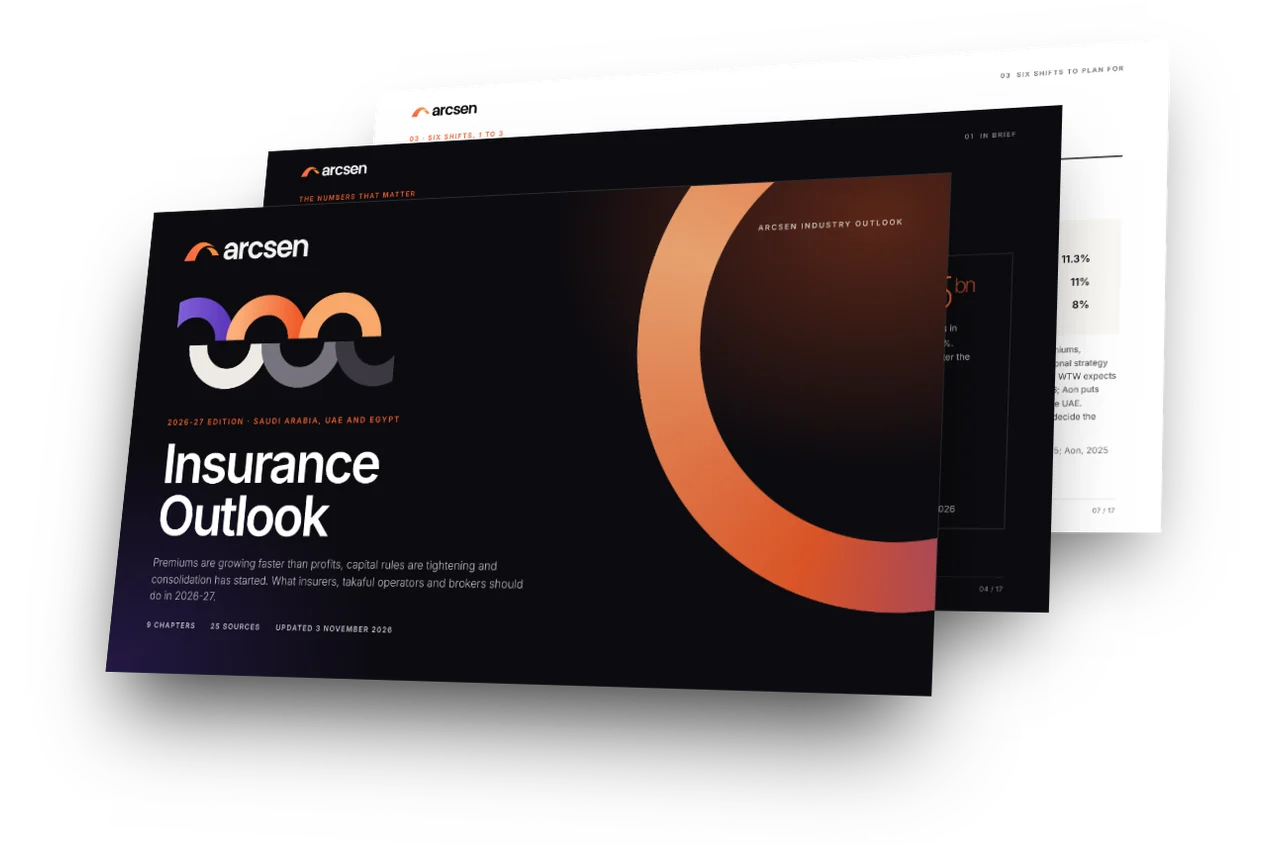
- 17Pages
- 9Chapters
- 25Sources
Take the outlook into your planning meeting.
The same research as this page, designed as 17 landscape pages with charts, a 2026-27 timeline and a priorities checklist. Free to download and share with your team.
Questions leaders ask
How big is the Saudi insurance market?
Gross written premiums were SAR 84.3 billion in 2025, up 10.7%, with health insurance at SAR 47.8 billion, or 57% (Insurance Authority). First-quarter 2026 premiums were SAR 29.8 billion, up 14.4%.
When does Saudi Arabia’s risk-based capital regime start?
Risk-based capital becomes mandatory on 1 January 2027. During 2026 insurers calculate solvency under both the current and the new regime, using a standard formula or an approved internal model (Insurance Authority, via Arab News).
Why did Saudi insurers’ profits fall in 2025?
Claims costs rose faster than premiums. Sector net profit fell 47% to SAR 1.9 billion (Insurance Authority), the listed insurers’ loss ratio rose to 89.3% (Milliman), and S&P puts the motor combined ratio at 107%.
How big is the UAE insurance market?
UAE gross written premiums were AED 74.8 billion in 2025, up 14.9%, across 58 insurers, and industry profit rose to AED 4.0 billion. Health policies rose 26% after the mandatory health scheme was extended to all emirates (Central Bank of the UAE).
How did the 2026 regional disruption affect Gulf insurers?
Mostly indirectly. Standard policies exclude conflict risks, so the effect came through repair, parts and medical costs (S&P). Specialty lines repriced sharply: Hormuz shipping cover rose from about 0.25% to as much as 10% of vessel value (Marsh).
Other outlooks for 2026-27
Eight more sectors, researched and sourced the same way.
Financial services outlook
Slower bank growth and tighter funding, open banking licensed in Saudi Arabia, real-time payments and fintech competition.
Read the outlook →Travel and transportation outlook
Recovery after the 2026 disruption, Saudi domestic travel, new airlines and rail, biometrics and AI.
Read the outlook →Retail and distribution outlook
Resident-led demand, electronic payments, paid membership, retail media, Egypt’s prices and e-invoicing.
Read the outlook →Public sector outlook
Agentic AI in government, published citizen-experience scores, single front doors and fewer steps.
Read the outlook →Healthcare outlook
Saudi health clusters, virtual care at scale, UAE health records, Egypt’s insurance rollout and supervised AI.
Read the outlook →Education outlook
National admissions platforms, AI in the curriculum, Dubai’s private-sector growth and cross-border recruitment.
Read the outlook →Automotive outlook
Deferred demand, weak brand loyalty, Chinese brands, aftersales, EV charging and new Saudi plants.
Read the outlook →Manufacturing outlook
Supply routes, local content rules, Saudi factory growth, Egypt’s exports and service on the installed base.
Read the outlook →Talk to the people behind this outlook
To discuss what it means for your organization, contact us directly.


Planning for 2026-27?
Talk to the people delivering Salesforce, Sitecore and Agentforce in Dubai, Riyadh, Jeddah, Doha and Cairo.
Sources and method
Arcsen is a Salesforce Summit Partner and Sitecore partner with teams in Dubai, Riyadh, Jeddah, Doha and Cairo. This outlook uses official statistics, regulator and government publications, company filings and established research, checked on 3 November 2026. Where a figure comes from a news report of official data, the source below names both. We update this page as new data is published.
- The Saudi Insurance Market Report 2025, Insurance Authority, July 2026.
- SAR 29.8 billion in gross written premiums in Q1 2026, up 14.4%, Insurance Authority, 8 September 2026.
- Saudi Insurance Authority announces transition to risk-based capital framework, Arab News, citing SPA, 5 April 2026.
- KSA industry update year end 2025, Milliman, 10 June 2026.
- Saudi insurance income climbs as smaller players narrow losses, EnterpriseAM, citing Moody’s, 7 September 2026.
- GCC insurers and the 2026 regional disruption, EnterpriseAM, citing S&P, 6 July 2026.
- AM Best maintains stable outlook for GCC insurance markets, Reinsurance News, 12 August 2026.
- Buruj Cooperative completes merger with Medgulf, Baker McKenzie, 4 November 2025.
- Salama EGM approves capital increase for merger with Enaya, Argaam, 5 January 2026.
- Growth and consolidation incoming for the Saudi insurance sector, EnterpriseAM, 22 January 2026.
- Understanding Saudi Arabia’s draft open insurance and insurtech framework, Al Tamimi & Co, 16 March 2026.
- Middle East healthcare costs to rise again in 2026, Consultancy-me, citing WTW, 17 December 2025.
- Global Medical Trend Rates Report 2026, Aon, October 2025.
- UAE insurance premiums jump 15% to Dh74.8 billion as health and property cover grow, Khaleej Times, citing CBUAE, 25 August 2026.
- UAE insurance assets hit Dh164.9b as premiums surge 15%, Gulf News, 24 August 2026.
- CBUAE’s new insurance licensing regulation reshapes UAE market entry, Al Tamimi & Co, 2 September 2026.
- UAE Central Bank approves three new regulations in insurance licensing, brokerage and telemarketing, Gulf News, 16 December 2025.
- UAE open finance, Pinsent Masons Out-Law, 3 November 2025.
- Egypt’s Unified Insurance Law spells new players and market growth, Middle East Insurance Review, July 2026.
- FRA Chairman at AIO Conference: vast potential to expand and deepen Egypt’s insurance sector, Financial Regulatory Authority, 7 June 2026.
- Hormuz shipping cover rates expected to stay elevated, Insurance Business, citing Marsh, 28 June 2026.
- Marine insurers lose billions supporting Hormuz energy flows, Hellenic Shipping News, citing IUMI, 25 September 2026.
- Middle East: 1 July renewal rates drop 10-15% as focus stays on reinsurance continuity, Middle East Insurance Review, citing Guy Carpenter, August 2026.
- S&P on GCC insurers’ exposure to conflict-related claims, Khaleej Times, citing S&P, 12 August 2026.
- IMF cuts 2026 growth forecasts for Gulf economies due to prolonged Hormuz closure, The National, 13 October 2026.