
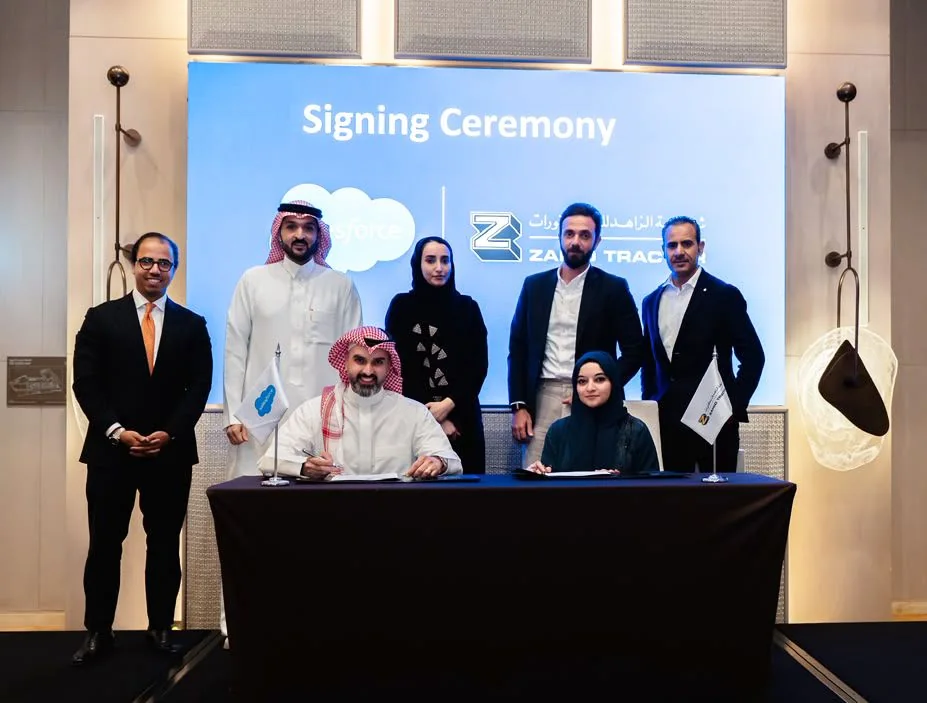
Zahid Group is a Jeddah-headquartered Saudi group whose companies include Zahid Tractor, Caterpillar’s dealer in the Kingdom. In June 2026, four of its business units went live on one Salesforce platform covering leads, quotes, agreements and service cases, with a customer portal and Infor M3 integration. Arcsen was the implementation partner, from discovery workshops through design, data migration, testing and enablement.

- Client
- Zahid Group
- Region
- Saudi Arabia, headquartered in Jeddah
- Scope
- Four business units: construction machinery, commercial vehicles, power and rental
- Platform
- Manufacturing Cloud, Revenue Cloud CPQ, Experience Cloud, Salesforce Knowledge
- Integrations
- Infor M3, Microsoft Outlook
- Status
- Live since June 2026
Phase 1 scope
What went live.
Leads and accounts
Leads arrive from campaigns, web forms and manual entry, then are scored, checked for duplicates and assigned by region and source, with SLA alerts. Accounts sit in parent and child hierarchies with their business units, branches, and bill-to, ship-to and project addresses. New accounts and address changes go through manager approval.
Opportunities, visits and forecasts
Opportunities open only on approved accounts and capture source, payment method and brand, plus the competitor on lost deals. One project can span several contractors and opportunities, and an approval matrix applies by deal value. Reps plan and log account visits against periodic targets, and forecasts run through hierarchies by value and volume.
Quoting on Revenue Cloud
Quotes come in five types: standard, equipment, after-sales, rental and product support. Bundles, options, promotions and pricing rules sit on price books set by geography and organization, in several currencies. Pricing outside internal standards goes through an approval matrix. Quotes are versioned and built from templates, and an accepted quote creates the order.
Agreements and service cases
Sales agreements link to their orders, invoices and billing, with warranties and service agreements managed alongside. Complaints and issues run as cases, with resolution tracked against the SLA in the service agreement, reporting by agent, team and account.
A customer portal
The portal runs on Experience Cloud, with Salesforce Knowledge for FAQs and articles. Customer administrators manage their contacts and preferences, raise support tickets, see campaign promotions, track orders, view past orders against agreements, check their assets, submit requests and RFIs on assets, and follow invoices and payment notifications.
Infor M3 and Outlook
Interfaces with Infor M3 carry customer and product data, price books, units of measure, currencies, quotes, orders, invoices and payments, each in a set direction. Outlook email and calendar activity syncs to Salesforce. Email alerts go out at set points in the service process and when tasks go overdue.
“Successful transformation is never about technology alone, it is about people, collaboration, and a shared commitment to excellence.”
Suzan Sadek, Group IT Manager, Zahid Group, on the go-live announcement
How delivery ran
How it was delivered.
Discover and design
Joint workshops set the requirements, customer processes and an MVP backlog. The solution design was approved before build, on a config-first rule: standard Salesforce features first, custom code only where it served revenue, compliance or customer experience.
Build in sprints
Build ran in two-week sprints, each ending in a demo, through developer, QA and UAT sandboxes. A joint steering committee with Zahid’s business and technology sponsors set direction.
Test and migrate
System integration testing concentrated on the Infor M3 touchpoints. Zahid’s super users then ran user acceptance testing on scripts written from the acceptance criteria. Test migrations had to pass quality checks before the full data load was scheduled.
Go live and hand over
Cutover was followed by smoke tests and joint checks of migrated data with Zahid’s IT and business teams. Trainers and administrators from each business unit were trained and given manuals, then hypercare began.
Go-live was day one. Phase 2 is now under way, with the engagement continuing into run, adoption and what the platform enables next for the group. Read the go-live announcement.
What’s next
Field Service, across the group.
Shortly before LEAP 2026, Zahid Group signed the next phase of its Salesforce programme with Salesforce and Arcsen: Field Service on Salesforce, which takes the platform deeper across the group’s businesses. Read about LEAP 2026.
Questions
About this engagement.
Where does Infor M3 stop and Salesforce start?
Products, price books, units of measure, currencies, invoices and payments come from Infor M3 into Salesforce. Quotes and quote lines are built in Salesforce and sent to M3. Customers, contacts, addresses, orders and order lines sync both ways. System integration testing covered these flows before go-live.
Can one platform serve business units that sell different things?
Yes. Business units and sub-units are managed under each account, price books are set by geography and organizational structure, and approval matrices apply by deal value. Reps see and edit their own records, managers see their team’s, and records can be shared with set access levels.
Can quotes go out in Arabic and in other currencies?
Yes. Quotation templates are set up in English and Arabic, chosen by opportunity and quote type, and can be previewed and edited before sending. Price books hold several currencies, currency data comes from Infor M3, and each quote records its own language and currency.
How was existing data brought across?
In stages. Zahid’s team prepared and cleansed the source data, and Arcsen loaded it through staging, a quality assessment and a validation sandbox, with trial runs before the production load. Business users then checked the migrated records in production. Duplicate and matching rules now check new leads, accounts, contacts and addresses.
Bringing several businesses onto one platform?
Or see our automotive and manufacturing practices, or start with a free Salesforce health check.